Round tables seat eight to ten guests and make conversation easy, while long tables look dramatic and suit a family-style feel. Start with the hall floor plan, place the dance floor and the couple first, then seat guests in groups who know each other. Finalise the seating plan two weeks before the wedding.
A seating plan does two jobs. It decides how the room looks, and it decides who each guest spends three hours beside. Start with the shape of the hall and the tables, fix the positions of the dance floor and the couple, and then place your guests in groups that will enjoy each other's company. Done in that order, the task is far less daunting than it first appears.
This guide covers table shapes, room layout, who sits where and a step-by-step method for getting it finished.
Round tables or long tables?
| Feature | Round tables | Long tables |
|---|---|---|
| Guests per table | 8 to 10 | 8 to 12 per standard trestle run, or many more in a continuous row |
| Conversation | Everyone can see and speak to each other | Guests speak mainly to neighbours and those opposite |
| Look | Classic and balanced | Dramatic lines, modern or rustic |
| Decor | One centrepiece per table | Runners, repeated arrangements and candles along the length |
| Space | Uses more floor area per guest | Efficient in a rectangular room |
| Movement | Easy for waiters to circulate | Needs planned gaps for service |
| Seating plan | Simpler to group guests | Harder to place groups of odd sizes |
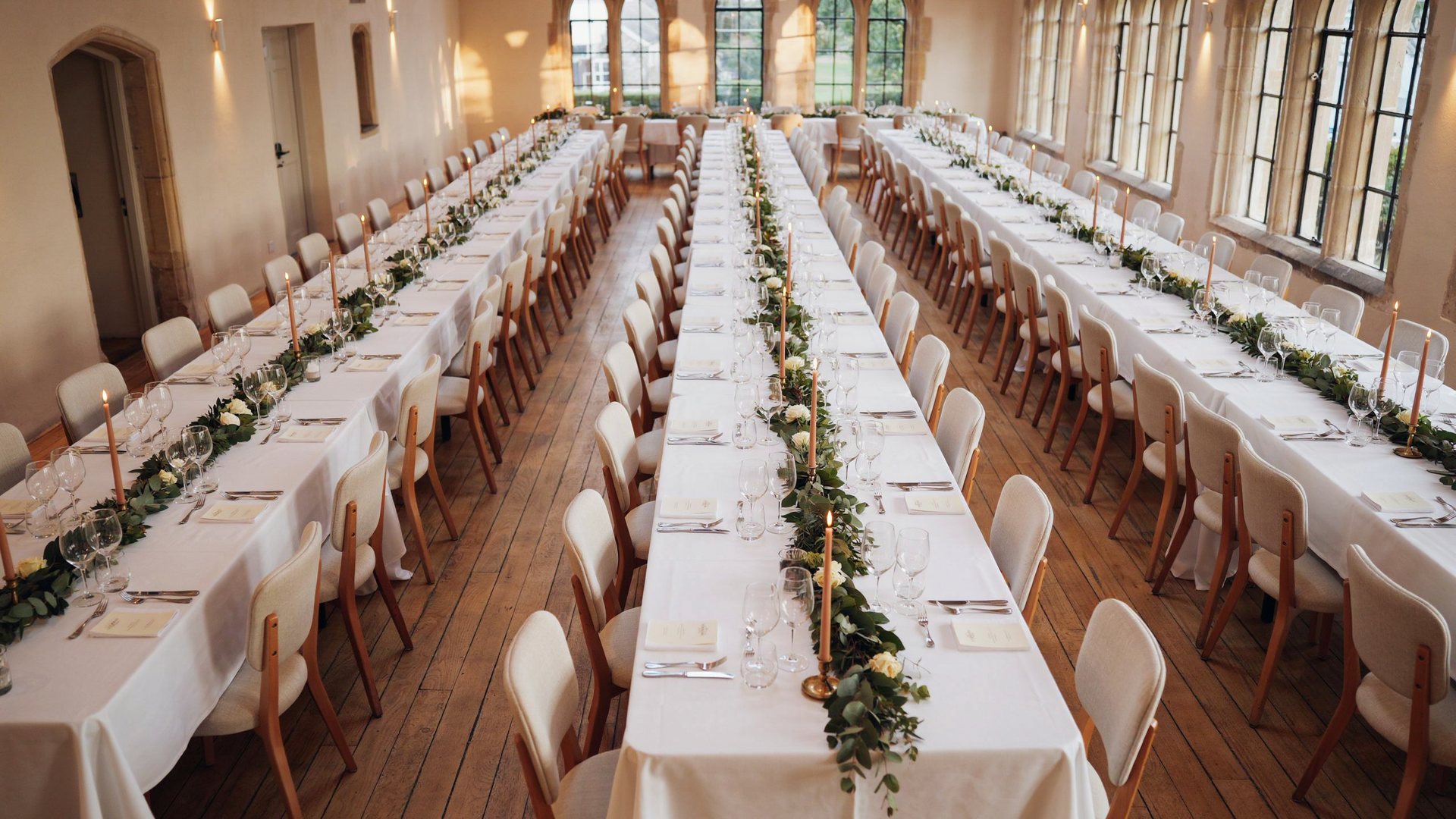
Neither is right or wrong. Round tables suit mixed groups and plated service. Long tables suit a family-style mood and look striking in photographs. A combination is also popular, for example a long top table for the bridal party with round tables for guests.
Other shapes
- Square tables seat eight and feel contemporary, but take up a lot of room.
- A single long table suits small weddings of up to about 40.
- A U-shape or E-shape suits medium weddings where you would like everyone connected.
How do you lay out the room?
Ask your venue for a floor plan with measurements, then work in this order.
- Mark the fixed points. Doors, the kitchen entrance, the bar, pillars, windows and power points.
- Place the dance floor. Central is best, so that every table has a view and the party is not pushed to one end.
- Place the couple. They should be visible from every seat, ideally with a good backdrop behind them.
- Place the DJ or band. Beside the dance floor, near power, with speakers not pointing straight at older guests.
- Add the guest tables. Arrange them around the dance floor, closest tables for family and the bridal party.
- Check the gaps. Leave enough room between chairs for waiters and guests to pass comfortably when people are seated.
- Add the extras. Cake table, gift table, guest book, photo corner and a lounge area if there is room.
Riverbed Hall at Oxbow Country Estate seats up to 200 guests with a dance floor. Ask the estate which layouts work best for your number, since the team knows how the room behaves at 60, 120 and 200.
How many tables will you need?
A quick guide using round tables of ten:
| Guests | Round tables of 10 | Round tables of 8 |
|---|---|---|
| 60 | 6 | 8 |
| 100 | 10 | 13 |
| 150 | 15 | 19 |
| 200 | 20 | 25 |
Seating eight at a table is more comfortable than ten, but needs more tables, more centrepieces and more floor space. Confirm the table sizes your venue supplies before you plan.
Where should the couple sit?
There are three common choices.
- A traditional top table. The couple sits in the middle with parents and the bridal party on either side, facing the room. It is formal and gives everyone a view, though those seated cannot easily talk to each other.
- A sweetheart table. The couple sits alone at a small table. It guarantees you a few quiet moments and frees the bridal party to sit with their partners.
- Among the guests. The couple sits at a round or long table with family or the bridal party. It is relaxed and sociable.
If your parents are divorced or family relationships are delicate, a sweetheart table with separate family tables nearby is often the kindest solution.
Who sits where?
A few conventions make the decisions easier.
- Family closest. Parents, grandparents and siblings take the tables nearest the couple.
- Bridal party next. With their partners, if they are not at the top table.
- Group by connection. School friends, university friends, work colleagues and family branches each form natural tables.
- Mix thoughtfully. If a table must be mixed, make sure each person knows at least one other.
- Seat older guests with care. Away from speakers, near the exit and bathrooms, and with a clear view.
- Seat children with parents. Or at a children's table close to them if there are several of similar age.
- Keep couples together. Splitting partners is an old custom that few guests enjoy.
- Avoid a leftovers table. Spread single guests and those who know few people among friendly tables.
Assigned seats or assigned tables?
- Assigned tables tell guests which table they are at and let them choose a chair. This is the usual approach and works well for most weddings.
- Assigned seats place each guest at a specific chair with a name card. This takes more effort but is helpful for a plated meal with special dietary requirements, because the kitchen and waiters know exactly where each meal goes.
A middle path is to assign tables for everyone and place name cards only for guests with dietary needs. Ask your venue which it prefers.
A step-by-step method
- Wait for the RSVPs. Start only once most replies are in.
- List every confirmed guest in a spreadsheet with a column for group, dietary needs and table number.
- Sort into groups of people who know each other.
- Draw the room on paper or use a seating tool, with tables numbered.
- Place the couple and family tables first.
- Fill outward from the dance floor, group by group.
- Resolve the awkward ones. There are always a few. Move them last.
- Ask one other person to check it. A parent from each side is ideal.
- Send it to the venue with dietary notes, usually two weeks before.
- Stop changing it. Late changes cause more errors than they fix.
How do guests find their seats?
- A seating chart. A large board at the entrance listing names by table, or alphabetically, which is quicker to read for more than 80 guests.
- Escort cards. Individual cards with each guest's name and table number, arranged on a table.
- Table numbers or names. Clear, tall enough to see across the room and matched to the chart.
- Place cards. At each setting, if you are assigning seats.
Print names large enough to read in low light, and place the chart where a crowd can gather without blocking the door.
How does table decor fit in?
The table shape drives the decor.
- Round tables need one arrangement in the centre. Keep it either low enough to talk over or tall and slim enough to see under.
- Long tables look best with a runner of foliage, small arrangements repeated along the length and plenty of candles.
- Leave room for the meal. Plated service brings plates, side plates, several glasses and bread to the table. Do not fill every centimetre with decor.
- Use candlelight. It flatters everyone and warms a large room.
For more on styling, see our article on wedding decor ideas and themes.
Common mistakes
- Planning the seating before the RSVPs are final
- Placing the dance floor far from the tables
- Seating older guests next to the speakers
- Forgetting seats for the photographer, DJ and coordinator
- Tables so close together that waiters cannot pass
- Centrepieces that block the view of the couple
- A chart with print too small to read
To see how your numbers fit the room, book a site visit and ask about layouts, or start with an estimate from the wedding quote builder.
Frequently asked questions
Are round or long tables better for a wedding?
Round tables are better for conversation and easy service. Long tables create a striking look and a family-style atmosphere. Many couples use a mix, with a long top table and round guest tables.
How many guests fit at a round wedding table?
Standard round tables seat eight comfortably or ten at a squeeze. Confirm the size of table your venue supplies, since this changes how many you need.
When should I finalise the wedding seating plan?
About two weeks before the wedding, once RSVPs are in. Send it to the venue with dietary requirements at the same time, and avoid changes after that.
Where do parents sit at a wedding reception?
Parents sit either at the top table with the couple or at the tables closest to it. If parents are divorced, give each their own table of family and friends near the front.
Do I need assigned seats or just assigned tables?
Assigned tables are enough for most weddings. Assigned seats are helpful when you have a plated meal with special dietary requirements, as the service team can find each guest easily.
How many guests can Riverbed Hall seat?
Riverbed Hall at Oxbow Country Estate seats up to 200 guests with a dance floor. The estate can advise on layouts for smaller numbers too.